

By Dimitris Kontogiannis
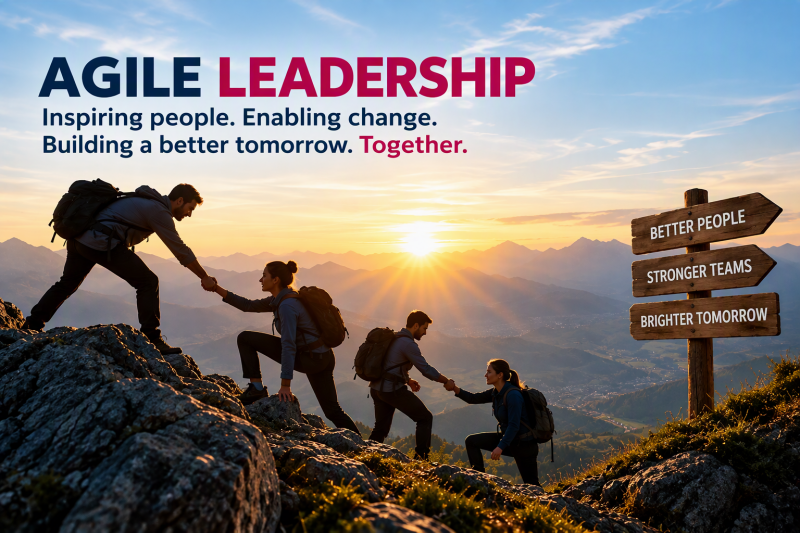
“Great leaders don’t simply lead transformation. They inspire others to embrace it, believe in it and make it happen together.”
Transformation is often described through strategies, operating models, technologies, structures and processes. Yet none of these can create lasting change on their own.
At the heart of every successful transformation are people. And people do not truly follow plans.
They follow leaders they trust, visions they believe in and journeys on which they feel they have a meaningful role.
This is where leadership and the Agile mindset come together.
Great leaders understand that leadership is not management. Management has its place. Organizations need coordination, planning, structure and control.
But transformation requires something more.
It requires the ability to create direction, generate belief, remove obstacles and give people the confidence to move forward, particularly when the destination is not entirely clear. And leadership begins with example.
We cannot ask people to collaborate if we protect our own territory. We cannot ask for transparency while hiding uncomfortable information. We cannot encourage experimentation while punishing failure. And we cannot expect people to change if we are unwilling to change ourselves. What leaders consistently do, has far greater influence than what they occasionally say.
At the same time, leadership requires fairness and foresight.
A leader must be present enough to understand today's reality while looking far enough ahead to anticipate tomorrow. This does not mean predicting the future. It means creating a clear sense of direction while remaining ready to adjust the route.
That is one of the most powerful connections with Agile.
Being Agile does not mean moving quickly without direction. It means knowing where we want to go while accepting that we may need to change how we get there. We define a path towards success, choose the right tools and ways of working, measure progress, learn continuously and adjust when evidence tells us that something is not working.
But transformation cannot depend on the leader alone.
Leadership is also about helping others become better. Great leaders inspire, challenge, support and create the conditions in which people can continuously improve. They do not have or pretend to be the smartest person in the room. They ask questions, listen carefully, encourage different perspectives and help people discover solutions themselves.
In that sense, the leader should strive to be first among equals.
Leadership brings responsibility, but it should not create distance. A leader should be part of the journey, sharing the vision repeatedly and turning that vision into something people can understand, challenge, influence and ultimately make their own.
This requires one of the foundations of Agile thinking: transparency, inspection and adaptation.
Transparency allows us to see reality as it is, not as we would like it to be. Inspection gives us the courage to examine our progress, decisions, assumptions and behaviors.
Adaptation turns what we learn into action. Together, these principles create an environment where improvement becomes continuous rather than occasional.
The same mindset changes our relationship with mistakes.
Great leaders make mistakes. The difference is that they recognize them, take responsibility for them, learn from them and adapt.
A mistake honestly acknowledged can strengthen trust. A mistake hidden or defended can destroy it.
In an Agile culture, failure should not become an excuse for poor performance, but neither should it become something people fear. Responsible experimentation creates learning and learning creates progress.
Perhaps most importantly, leadership cannot be driven by a self-strategy.
Leadership is not about protecting status, increasing personal visibility, or proving that we were right.
Our strategy should serve something larger: improving the organization, creating value, developing people and leaving the system stronger than we found it.
Ultimately, Agile leadership is not about frameworks, ceremonies, boards, backlogs, or terminology. These are tools and tools are valuable only when they serve a purpose.
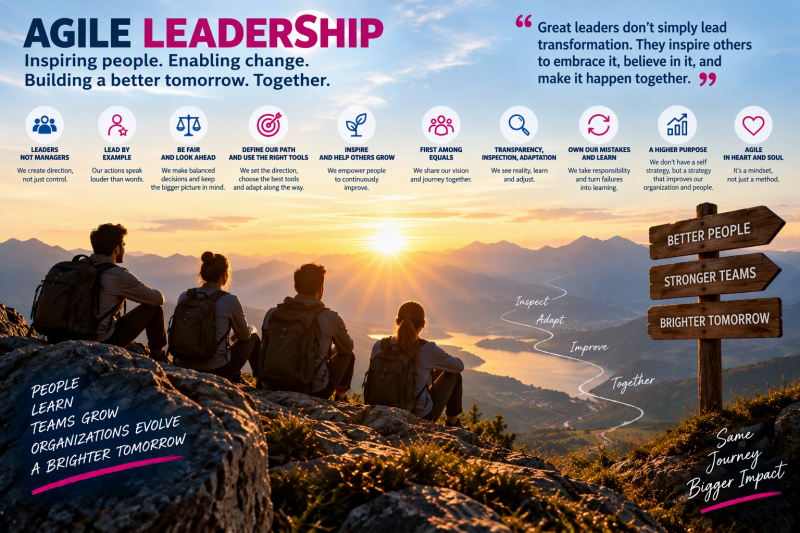
Agility begins with mindset.
It is the willingness to listen before deciding. To learn before assuming.
To adapt instead of defending. To share instead of controlling.
To trust people while remaining accountable for outcomes. To have a clear vision without pretending to know every step of the journey.
Great leaders do not stand in front of transformation asking others to follow. They step into it with their people.
They create direction, demonstrate the behaviors they expect, learn from reality, adapt continuously and inspire others to take ownership of the journey.
Because transformation succeeds when it stops being the leader’s transformation and becomes our transformation.
And that is what it truly means to build a better tomorrow together!
👉 Share your thoughts in the comments! Have you set your Agile mindset free? Share your thoughts and insights in the comments below! 🗨️
Add comment
Comments