

💭A different kind of question
Over the last few years, organizations across the world have been investing heavily in Artificial Intelligence. 🤖
New tools appear almost daily. New capabilities emerge continuously. Technology leaders, HR departments, learning teams and business executives are all exploring how AI can help organizations become more productive, more innovative and better prepared for the future.
At the same time, employees are discovering new ways to simplify their work, generate ideas, analyze information and make decisions faster than ever before.
As a result, one question seems to dominate almost every discussion: How do we help people use AI effectively? 🤖
It is a reasonable question. In fact, it is probably one of the most important questions organizations are trying to answer right now.
Yet the more I observe how people interact with AI, the more I begin to wonder if we are focusing on the wrong problem.
Perhaps the challenge is no longer teaching people how to use AI. Perhaps the challenge is teaching people how to work with AI. 🤝
And those are two very different things.
Using AI is primarily about tools, prompts and technology. Working with AI is about collaboration, judgement, critical thinking, learning and trust. 🤝
The first teaches us how to get answers. The second teaches us how to create better outcomes. 🎯
As AI gradually transitions from tool to assistant, from assistant to co-worker, this distinction becomes increasingly important. 🚀
And if the nature of work is changing, perhaps the way we support people through that change needs to evolve as well.

🧰When tools become team members
For decades, technology has been a tool.
A calculator helped us calculate. Excel helped us organize information. A search engine helped us find information. A project management application helped us organize work. 📊
These tools were useful, but they were passive. They waited patiently until we asked them to do something. We remained the ones with the experience, the understanding and the judgement.
These tools were simply there to support us when we needed assistance.
Artificial Intelligence is changing that relationship.
Today's AI can write, analyze, summarize, challenge assumptions, identify patterns, generate ideas, learn from context and support decision-making. Tomorrow's AI will become even more proactive.
Imagine beginning your workday and hearing:
“Dimitris, I reviewed your calendar. The meeting with the leadership team overlaps with two critical deadlines.”
“The action agreed last week is still missing an owner.”
“You are about to make a decision. Here are three risks that have not been discussed yet.”
This is no longer a tool. It is beginning to resemble a co-worker. 🤝
And whenever the way we work changes, every employee must evolve as well.
🧠A new literacy is emerging
Many people believe the key skill of the future is prompting. I totally disagree. ✍️
Prompting is only the visible tip of the iceberg. The real skill is something much deeper.
It is the ability to think clearly. 🧠
- Understand the problem. ✅
- Provide meaningful context. ✅
- Challenge assumptions. ✅
- Formulate intelligent questions. ✅
- Validate the answers received. ✅
In reality, AI is exposing something that has always existed.
The quality of the answer depends largely on the quality of the thinking behind the question.
A vague question usually produces a vague answer. A thoughtful question often produces extraordinary insights.
The difference is rarely the technology. The difference is the person using it. 💡
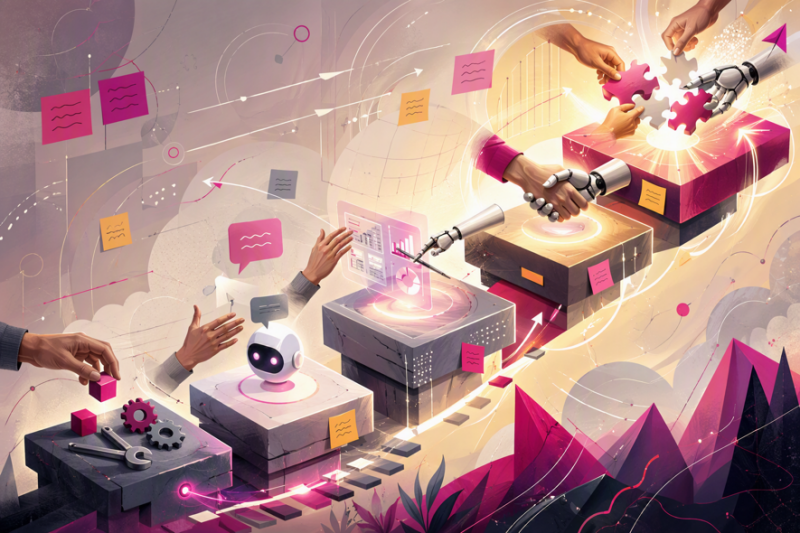
🔄The evolution of coaching
Before we speak about the future of coaching, it is worth asking a simple question: what is a coach?
At its core, a coach is someone who helps people think better, grow with intention and move from insight to action.
There are many types of coaches. But how has coaching evolved? And perhaps more importantly, where is it heading next?
Coach 1.0 – The Expert 🎓
The coach transferred knowledge. The focus was expertise.
“I know something you do not know, and I will help you learn it.”
Coach 2.0 – The Agile Coach 🔄
The Agile movement changed the game. The coach became less of a traditional expert and more of a facilitator, mentor, consultant and systems thinker.
The focus moved toward:
- Team dynamics 🤝
- Continuous improvement 🔄
- Systems thinking 🧩
- Self-organization 🌱
- Learning cultures 📚
The goal was not to provide answers.
The goal was to help teams discover answers themselves.
Coach 3.0 – The Human-AI Collaboration Coach 🤖🤝
Organizations have already started investing in AI. The next investment may not be technological at all. 🌱
It may be human. Because sooner or later every organization will have to answer a new question:
How do we help people collaborate with intelligence that is not human? 🤖🤝
The Human-AI Collaboration Coach may represent one possible answer.
The Human-AI Collaboration Coach will help people develop the capabilities required to thrive alongside intelligent systems. Not by replacing human thinking, but by enhancing it.
The focus shifts toward:
- AI literacy 🤖
- Critical thinking 🧠
- Decision quality 🎯
- Prompt design ✍️
- Cognitive awareness 🧭
- Ethical AI usage ⚖️
- Responsible experimentation 🧪
- Human judgement 🧠
⚠️The hidden risk nobody talks about
I occasionally see people accepting an AI-generated answer simply because it sounds convincing. ⚠️
Interestingly, the opposite behavior is usually displayed by experienced professionals.
Experts tend to challenge the answer, ask follow-up questions and request additional evidence. 🔍
They interact with AI less like a search engine and more like a colleague whose ideas deserve exploration but not blind acceptance. 🧠
Perhaps this is one of the most important skills we need to preserve.
Most conversations about AI focus on capability. How powerful AI will become. How fast it will evolve. How many tasks it will automate.
I believe a greater challenge exists.
Dependency. ⚠️
The danger is not that AI gives us wrong answers. The danger is that we stop questioning the answers altogether. ⚠️
This leads to a deeper question: how do we remain intelligent when intelligence is no longer exclusively human? 🧠
Throughout history, progress has always required critical thinking. Healthy skepticism. Curiosity. Challenge. Reflection. 💭
If AI becomes our co-worker, these qualities become even more important.
The future professional will need two complementary skills:
AI Collaboration 🤝
Getting the best possible insights from AI. 💡
AI Verification 🔍
Knowing when AI is wrong. 🔍
Knowing what might be missing. 🧩
Knowing when human experience and judgement should prevail. 🧠
Without the first skill, people struggle to unlock the value of AI.
Without the second skill, people risk becoming dependent on it.
Neither extreme is desirable. The magic happens somewhere in the middle.
🔄What happens to Agile?
As Agile practitioners, we cannot avoid asking an uncomfortable question.
One of the core values of the Agile Manifesto states: “Individuals and interactions over processes and tools.” 🤝
A reasonable question emerges.
What happens when one of the participants in the interaction is no longer human? 🤖
Does the value still apply?
I believe it does. More than ever! 🔄
Agile was never about elevating humans above technology.
Agile was about recognizing that meaningful outcomes emerge through collaboration, adaptation, learning and trust.
AI can provide information. AI can generate options. AI can accelerate analysis.
But AI does not build trust. 🤝
AI does not create psychological safety. AI does not inspire people during difficult moments. AI does not show empathy. 🛡️
The future of Agile may therefore be less about frameworks and more about helping humans and AI collaborate effectively to create value together. 🎯
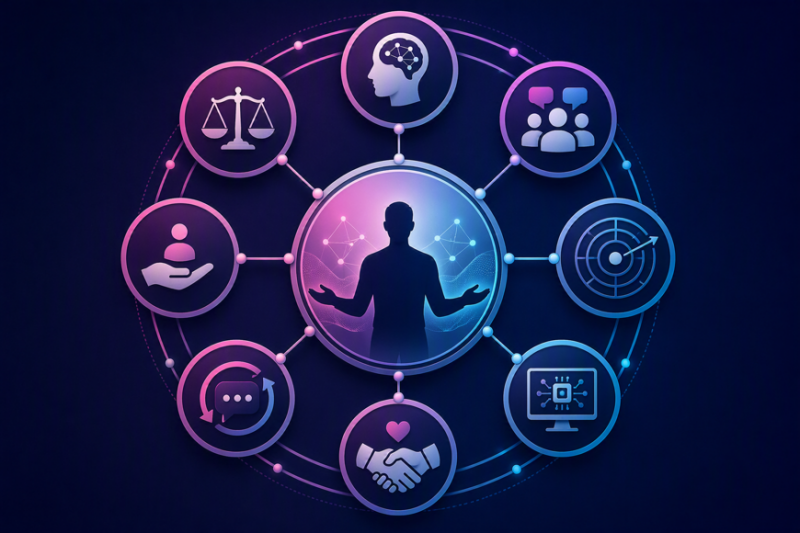
🤖From AI Agent to AI Co-worker
Personally, I have never been particularly excited by the term “AI Agent.” 🤖
It sounds mechanical. Transactional. Functional.
I find the term “AI Co-worker” far more interesting. 🤝
A good co-worker does not wait for instructions. A good co-worker contributes. Challenges assumptions. Shares observations.
A good co-worker raises concerns. Brings ideas. Supports better outcomes.
Perhaps that is exactly where AI is heading.
Not toward replacing people. Toward collaborating with them.
And if that vision becomes reality, organizations will need a new generation of coaches capable of helping people navigate this relationship.
The more I use AI, the less I see it as a source of answers.
I increasingly see it as a thinking partner. 💡
Not because it is always right.
Quite the opposite.
Some of the most valuable insights emerge when I disagree with the answer it provides. 💡
The discussion itself becomes the source of learning. 📚
And perhaps that is exactly where coaching and AI begin to intersect. 🤖🤝
🚀The future coach
Twenty years ago, coaching helped people navigate complexity created by technology.
Today, technology is no longer simply creating complexity. It is beginning to participate in the conversation. 💬
As AI evolves from tool to assistant and from assistant to co-worker, a new coaching discipline may emerge. 🌱
Not to help humans compete with AI. Not to help AI replace humans.
But to help humans and AI achieve more together than either could achieve alone. 🤝
The future coach will still be an Agile Coach. An agile coach who has a purpose.
Helping people learn. Helping teams adapt. Helping organizations thrive. 📚
And now, perhaps, helping humans and intelligent co-workers collaborate in ways we are only beginning to imagine. Because we are entering a world where intelligence is no longer found only in people. It is becoming part of the working environment itself. 🌍
And if that is true, then the journey from Agile Coach to Human-AI Collaboration Coach may have already begun. 🚀
👉 Share your thoughts in the comments! Does your summer holidays follow an agile approach? Let us know! 💬
Add comment
Comments